Sadturn
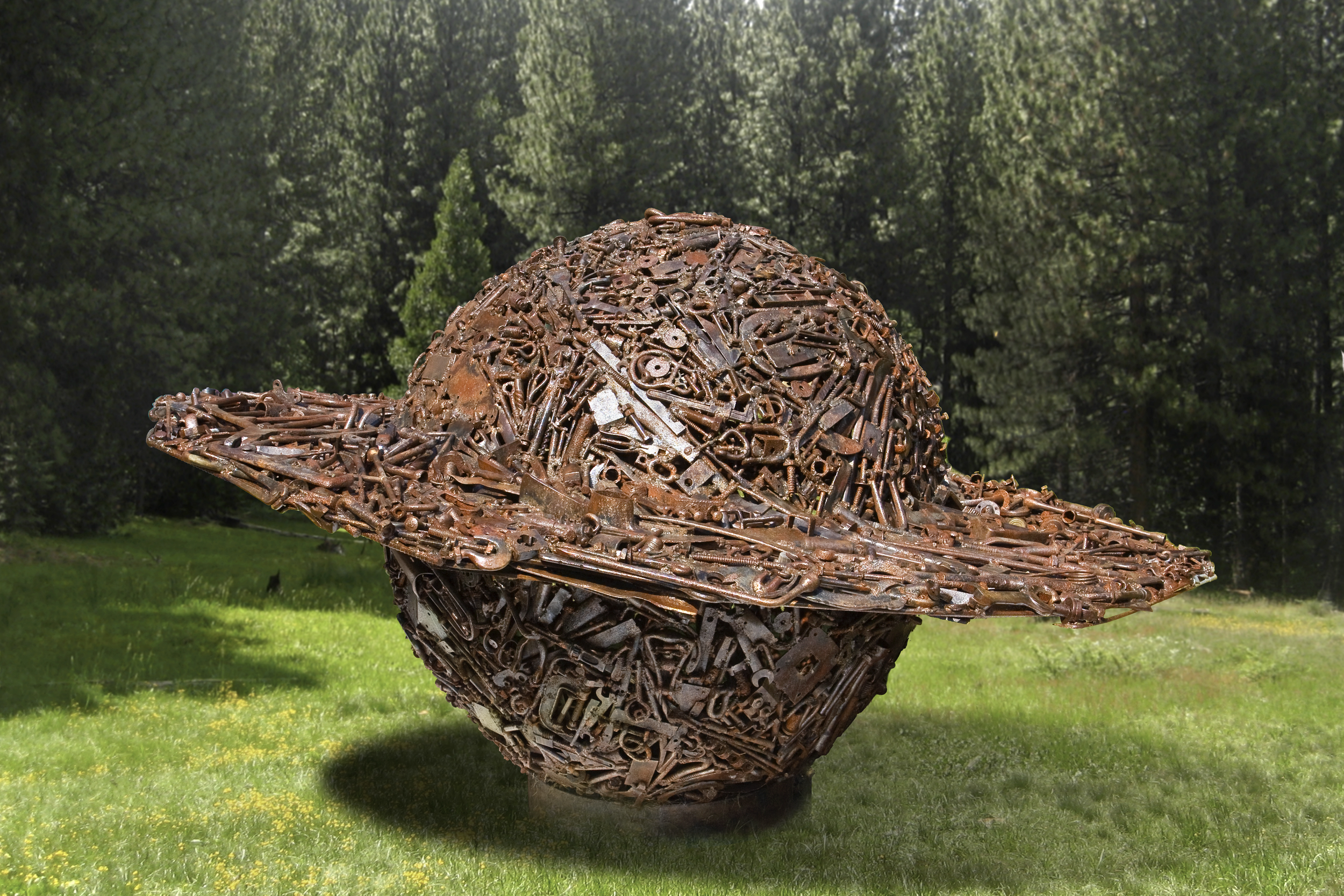
Sadturn, a large-scale work that transforms discarded objects into a powerful reflection on environmental accumulation and human impact will be on display at Art in the Park this fall .
Weighing 3,000 pounds and composed of over 4,000 individual welds, Sadturn was constructed over five years using salvaged materials rooted in New England’s industrial and domestic history—ice tongs, doorknobs, faucets, tools, and countless other remnants of everyday use. Each object carries a prior life, now reassembled into a unified, planetary form.
The origin of the work traces back to a seemingly insignificant moment. While purchasing a small item, Kitchen watched as it was automatically placed into a plastic bag—an object destined to outlast generations.
“I remember thinking the bag might take a thousand years to disappear,” Kitchen recalls. “It was Earth Day, and I began to imagine a world shaped by everything we casually discard.”
That moment led to the initial vision: a massive sphere composed entirely of waste—a physical manifestation of accumulation. Over time, as the sculpture evolved, its form shifted. The central mass opened outward, creating a ring and transforming the piece into a likeness of Saturn.
This transformation deepened the work’s meaning. Scientists have noted that Earth itself is now encircled by a growing field of orbital debris—an unintended ring of human-made remnants. In this way, Sadturn becomes both symbolic and literal: a reflection not only of terrestrial waste, but of humanity’s expanding footprint beyond the planet.
Kitchen’s connection to Earth Day is personal. As a young student in Wisconsin, he witnessed the founding of Earth Day by Senator Gaylord Nelson and recalls the early optimism that marked the movement’s beginning.
“At the time, it felt like a turning point—that we might begin to take better care of the Earth. Years later, standing in that store, I realized how little had changed.”
Despite its weight and scale, Sadturn invites close, sustained looking. Viewers often engage with the sculpture as a kind of visual search—recognizing familiar objects embedded within the surface, from ice tongs to tools and household fixtures. This “Where’s Waldo” quality creates an accessible entry point, drawing viewers in before revealing the larger, more unsettling whole.
When first installed, visitors unknowingly created a worn path in the grass around the sculpture—forming a new “ring” through repeated movement. This unintended interaction became part of the work itself, echoing both Saturn’s form and the cyclical nature of human behavior.
Sadturn stands as both artifact and mirror—assembled from the past, speaking to the present, and asking what future we are in the process of constructing.